Michael Koppmann
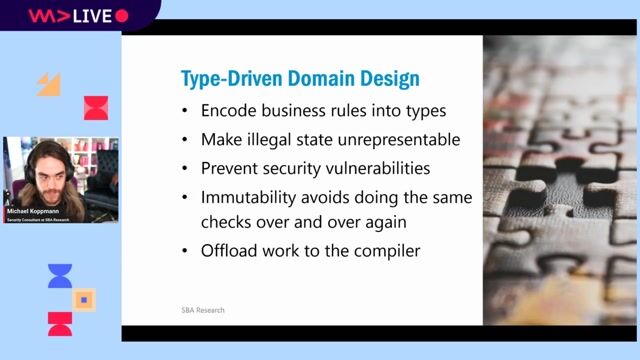
Typed Security: Preventing Vulnerabilities By Design
#1about 3 minutes
Introduction to domain-driven design principles
Domain-driven design (DDD) helps structure code to match the business domain by using concepts like entities, value objects, and aggregates.
#2about 4 minutes
Making illegal states unrepresentable with types
By designing data types so that invalid combinations cannot be expressed, the compiler can prevent bugs and enforce business rules automatically.
#3about 3 minutes
Avoiding null pointer exceptions with optionals
Using the `Optional` type in languages like Java explicitly models the potential absence of a value, forcing developers to handle empty cases.
#4about 2 minutes
Overcoming primitive obsession with custom types
Wrapping primitive types like strings and integers in custom types (e.g., `UserId`) prevents logical errors like mixing up different kinds of IDs.
#5about 9 minutes
Modeling a business workflow with rich types
An email verification process is modeled using smart constructors and sum types, replacing a simple boolean flag to guarantee correctness.
#6about 2 minutes
Applying typed security to OWASP vulnerabilities
Type systems can be used to systematically prevent common security flaws listed in the OWASP Top 10, such as injection and access control issues.
#7about 7 minutes
Using types as authorization tokens
Replacing boolean authorization checks with type-based access tokens ensures that protected functions can only be called after a successful permission check.
#8about 2 minutes
Preventing SQL injection with a query type
Differentiating between a raw string and a dedicated `Query` type at the compiler level prevents accidental string concatenation and forces safe data handling.
#9about 4 minutes
Preventing data leaks with data transfer objects
Data Transfer Objects (DTOs) act as a boundary layer, exposing only necessary and safe data to external clients while protecting sensitive internal models.
#10about 2 minutes
Eliminating XSS with a dedicated HTML type
In frameworks like Elm, treating HTML as a distinct type ensures that all string inputs are automatically sanitized, preventing cross-site scripting attacks.
#11about 2 minutes
Structuring applications with clean architecture
Architectural patterns like Clean or Hexagonal Architecture isolate the pure business logic core from external dependencies, complementing a type-driven approach.
#12about 2 minutes
Key takeaways for building secure applications
The core principles for secure design are to make illegal states unrepresentable, parse instead of just validating, and use the compiler as a security tool.
#13about 17 minutes
Q&A on type systems and legacy code
The speaker answers audience questions about effective languages, limitations, frontend vs backend validation, and applying these concepts to legacy codebases.
Related jobs
Jobs that call for the skills explored in this talk.


Matching moments
02:26 MIN
Why developers make basic cybersecurity mistakes
Don't Be A Naive Developer: How To Avoid Basic Cybersecurity Mistakes
Unlock Moments
Create a free account to watch a limited number of Moments each month.
Upgrade to PRO for unlimited access to the full archive.
Upgrade to PRO for unlimited access to the full archive.
You have an account? Log in
01:20 MIN
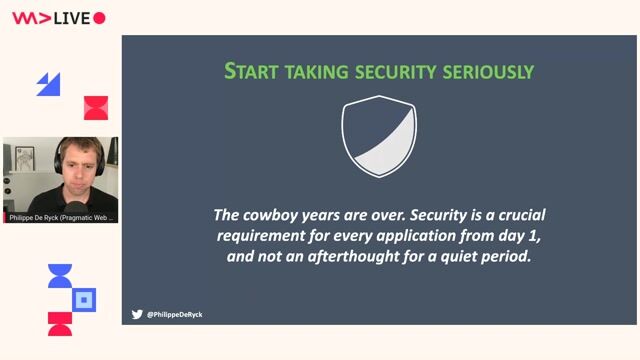
Focusing on secure architecture over just code
Architecting API Security
Unlock Moments
Create a free account to watch a limited number of Moments each month.
Upgrade to PRO for unlimited access to the full archive.
Upgrade to PRO for unlimited access to the full archive.
You have an account? Log in
01:58 MIN
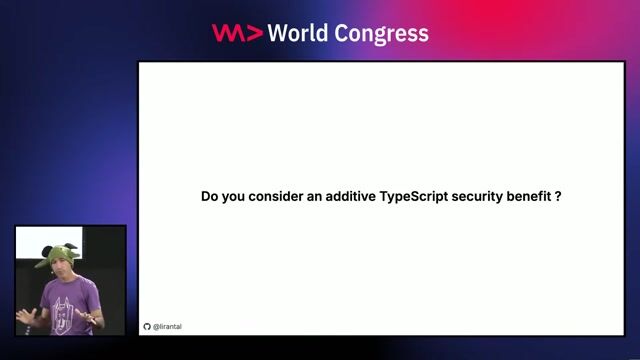
The common misconception of TypeScript as a security tool
Friend or Foe? TypeScript Security Fallacies
Unlock Moments
Create a free account to watch a limited number of Moments each month.
Upgrade to PRO for unlimited access to the full archive.
Upgrade to PRO for unlimited access to the full archive.
You have an account? Log in
02:00 MIN
Why TypeScript is like code coverage, not a security guarantee
Friend or Foe? TypeScript Security Fallacies
Unlock Moments
Create a free account to watch a limited number of Moments each month.
Upgrade to PRO for unlimited access to the full archive.
Upgrade to PRO for unlimited access to the full archive.
You have an account? Log in
01:09 MIN
Mitigating AI risks with security tools and awareness
Can Machines Dream of Secure Code? Emerging AI Security Risks in LLM-driven Developer Tools
Unlock Moments
Create a free account to watch a limited number of Moments each month.
Upgrade to PRO for unlimited access to the full archive.
Upgrade to PRO for unlimited access to the full archive.
You have an account? Log in
05:49 MIN
Moving beyond the "it just works" developer mindset
Don't Be A Naive Developer: How To Avoid Basic Cybersecurity Mistakes
Unlock Moments
Create a free account to watch a limited number of Moments each month.
Upgrade to PRO for unlimited access to the full archive.
Upgrade to PRO for unlimited access to the full archive.
You have an account? Log in
02:28 MIN
Key takeaways on IDE and developer tool security
You click, you lose: a practical look at VSCode's security
Unlock Moments
Create a free account to watch a limited number of Moments each month.
Upgrade to PRO for unlimited access to the full archive.
Upgrade to PRO for unlimited access to the full archive.
You have an account? Log in
04:09 MIN
Introduction to developer-first security and CTFs
Capture the Flag 101
Unlock Moments
Create a free account to watch a limited number of Moments each month.
Upgrade to PRO for unlimited access to the full archive.
Upgrade to PRO for unlimited access to the full archive.
You have an account? Log in
Featured Partners
Related Videos
 45:19
45:19Securing Frontend Applications with Trusted Types
Philippe De Ryck
 40:38
40:38How to Cause (or Prevent) a Massive Data Breach- Secure Coding and IDOR
Anna Bacher
 29:34
29:34You can’t hack what you can’t see
Reto Kaeser
 1:58:48
Software Security 101: Secure Coding Basics
Thomas Konrad
 29:47
29:47You click, you lose: a practical look at VSCode's security
Thomas Chauchefoin & Paul Gerste
 43:56
43:56Getting under the skin: The Social Engineering techniques
Mauro Verderosa
 27:41
27:41Friend or Foe? TypeScript Security Fallacies
Liran Tal
 31:13
31:13Lies we Tell Ourselves As Developers
Stefan Baumgartner
Related Articles
View all articles



From learning to earning
Jobs that call for the skills explored in this talk.


doinstruct Software GmbH
Berlin, Germany
Senior
GIT
JavaScript
TypeScript


Vesterling Consulting GmbH
€70-90K
Software Architecture
Pflegecampus21 GmbH
Remote
€55-80K
MySQL
DevOps
TypeScript
CodeKeepers GmbH
Hamburg, Germany
TypeScript
Continuous Integration
DL Remote
Dortmund, Germany
Remote
€80K
Node.js
TypeScript
AWS Lambda
DL Remote
Dresden, Germany
Remote
€80K
Node.js
TypeScript
AWS Lambda