Anja Kunkel
How to ignore bugs (safely)
#1about 1 minute
Defining bugs and the need for effective triage
Bugs are defined as flaws that cause unexpected behavior, but not all of them are equally important to fix.
#2about 3 minutes
Using a shopping cart analogy for bug severity
A physical shopping cart with different flaws illustrates how the context and user's goal determine a bug's actual severity.
#3about 3 minutes
Applying medical triage principles to software bugs
The START system from medicine provides a color-coded framework for rapidly categorizing bugs based on urgency.
#4about 3 minutes
A formula for calculating bug risk and severity
Bug risk can be calculated as the probability of occurrence multiplied by its severity, which includes user count, impact, and duration.
#5about 2 minutes
Breaking down risk: probability, users, and revenue impact
The key factors for assessing a bug's severity are its likelihood, the number of users affected, and its ultimate impact on revenue.
#6about 3 minutes
The role of time to notice and recover (DORA metrics)
The total time a bug exists is determined by the time to notice it (monitoring) and the time to recover (workflows), which are key DORA metrics.
#7about 4 minutes
Why a zero bug policy can be counterproductive
A strict zero bug policy can lead to over-prioritizing minor issues and prevent teams from working on high-value features.
#8about 1 minute
Defining what makes a bug important to your team
Instead of a blanket policy, teams should create a clear, shared definition of what constitutes an important problem to guide prioritization.
#9about 2 minutes
Q&A on safety-critical systems and customer feedback
The discussion covers adapting bug triage for safety-critical platforms, measuring user impact, and handling customer disagreements on bug priority.
Related jobs
Jobs that call for the skills explored in this talk.


Matching moments

01:16 MIN
The high cost of software bugs and why we study them
The Software Bug All Stars - and what we can learn from them
Unlock Moments
Create a free account to watch a limited number of Moments each month.
Upgrade to PRO for unlimited access to the full archive.
Upgrade to PRO for unlimited access to the full archive.
You have an account? Log in
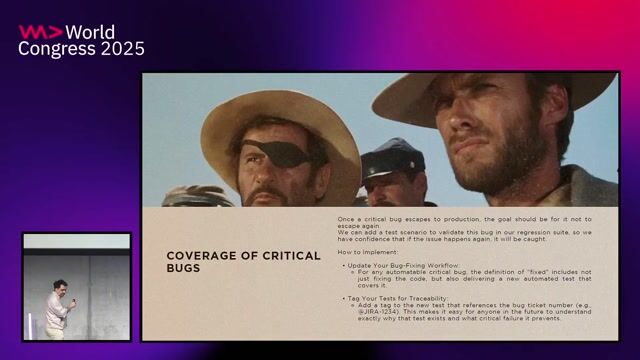
01:56 MIN
Providing security by automating critical bug coverage
How to add test automation to your project: The good, the bad, and the ugly
Unlock Moments
Create a free account to watch a limited number of Moments each month.
Upgrade to PRO for unlimited access to the full archive.
Upgrade to PRO for unlimited access to the full archive.
You have an account? Log in
03:00 MIN
The high cost and inherent challenges of software testing
How will artificial intelligence change the future of software testing?
Unlock Moments
Create a free account to watch a limited number of Moments each month.
Upgrade to PRO for unlimited access to the full archive.
Upgrade to PRO for unlimited access to the full archive.
You have an account? Log in

03:06 MIN
The power of curiosity and critical thinking in testing
Excellent Software Testing
Unlock Moments
Create a free account to watch a limited number of Moments each month.
Upgrade to PRO for unlimited access to the full archive.
Upgrade to PRO for unlimited access to the full archive.
You have an account? Log in
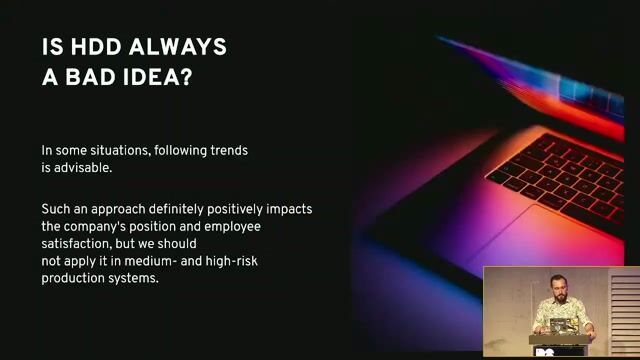
01:49 MIN
Balancing the risks and rewards of new technology
Resistant to hype: How to avoid being deceived by technological trends?
Unlock Moments
Create a free account to watch a limited number of Moments each month.
Upgrade to PRO for unlimited access to the full archive.
Upgrade to PRO for unlimited access to the full archive.
You have an account? Log in
00:57 MIN
Core requirements for effective bug resolution
Debugging in the Dark
Unlock Moments
Create a free account to watch a limited number of Moments each month.
Upgrade to PRO for unlimited access to the full archive.
Upgrade to PRO for unlimited access to the full archive.
You have an account? Log in
04:34 MIN
Understanding the traditional development bug cycle
Breaking the Bug Cycle: TDD for the Win
Unlock Moments
Create a free account to watch a limited number of Moments each month.
Upgrade to PRO for unlimited access to the full archive.
Upgrade to PRO for unlimited access to the full archive.
You have an account? Log in
04:03 MIN
Testing is a social and human-centric science
Excellent Software Testing
Unlock Moments
Create a free account to watch a limited number of Moments each month.
Upgrade to PRO for unlimited access to the full archive.
Upgrade to PRO for unlimited access to the full archive.
You have an account? Log in
Featured Partners
Related Videos
 27:54
27:54When testing just doesn’t cut it
Lars Hupel
 27:27
27:27The Software Bug All Stars - and what we can learn from them
Christian Seifert
 31:54
31:5482 Bugs I Collected in a Year You Won’t Believe Made It to Production
François Martin
 08:02
08:02Debugging in the Dark
Nishil Patel
 20:33
20:33Breaking the Bug Cycle: TDD for the Win
Nadeen Hussein
 28:12
28:12Your Testing Strategy is broken - lets fix it!
Luise Freese
 21:39
21:39Unveiling the Dark Side: Navigating the Pitfalls of Digital Ambitions
Johannes Hansen
 50:10
50:10Let's make your Java code Bug-Proof
Aicha Laafia
Related Articles
View all articles.png?w=240&auto=compress,format)


From learning to earning
Jobs that call for the skills explored in this talk.


Think-cell
Foster City, United States of America
Intermediate
Unit Testing
Manual Testing
Automated Testing





WeMatch GmbH
Continuous Integration
andrena objects ag