Luise Freese
Your Testing Strategy is broken - lets fix it!
#1about 3 minutes
Why high test coverage creates a false sense of security
High test coverage and green builds often mask underlying issues, serving as vanity metrics that don't guarantee software reliability for users.
#2about 4 minutes
Identifying common but ineffective testing habits
Teams often test from habit rather than intent, leading to tests that mock behavior, only cover the happy path, and test what's easy instead of what's risky.
#3about 2 minutes
Closing the gap between unicorn testing and real-world failures
Testing often occurs in a "unicorn land" of perfect inputs and APIs, failing to account for real-world conditions like flaky dependencies, malformed data, and concurrency issues.
#4about 3 minutes
Shifting left to focus on behavior-driven development
Good testing should be part of requirements engineering, using practices like BDD and example mapping to define expected behavior before writing code.
#5about 3 minutes
Rethinking the traditional testing pyramid
The classic testing pyramid overemphasizes unit tests, which can create a false sense of security while ignoring critical bugs that live in integration points and business flows.
#6about 2 minutes
Adopting practical test design and risk-based prioritization
Mature test design involves techniques like boundary value analysis and decision tables, focusing on covering behavior and having the confidence to not test what doesn't matter.
#7about 5 minutes
Using BDD and example mapping to align teams
Behavior-Driven Development is a communication tool that uses concrete examples to create a shared understanding of requirements across developers, QA, and product teams.
#8about 2 minutes
How blame culture undermines your testing strategy
If testing is used to avoid blame rather than improve software, even the best tools will only automate the wrong behaviors and fail to address underlying cultural issues.
#9about 2 minutes
Actionable steps to immediately improve your testing
Start improving your testing strategy by deleting a useless test, asking risk-focused questions, modeling scenarios before coding, and spotting "cover your ass" patterns.
Related jobs
Jobs that call for the skills explored in this talk.


Matching moments
04:03 MIN
Testing is a social and human-centric science
Excellent Software Testing
Unlock Moments
Create a free account to watch a limited number of Moments each month.
Upgrade to PRO for unlimited access to the full archive.
Upgrade to PRO for unlimited access to the full archive.
You have an account? Log in

01:56 MIN
Adopting a reasonable and pragmatic testing approach
How not to test
Unlock Moments
Create a free account to watch a limited number of Moments each month.
Upgrade to PRO for unlimited access to the full archive.
Upgrade to PRO for unlimited access to the full archive.
You have an account? Log in
02:50 MIN
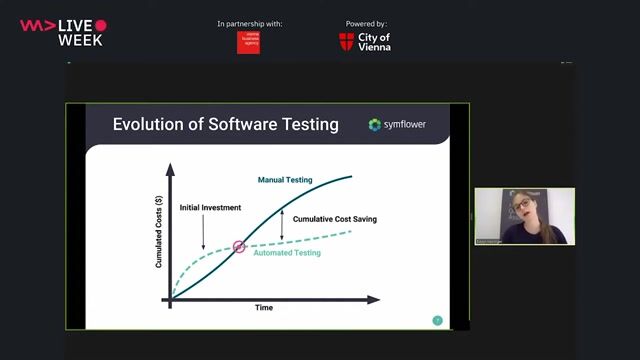
Why traditional testing methods fail to guarantee quality
How will artificial intelligence change the future of software testing?
Unlock Moments
Create a free account to watch a limited number of Moments each month.
Upgrade to PRO for unlimited access to the full archive.
Upgrade to PRO for unlimited access to the full archive.
You have an account? Log in

12:29 MIN
Q&A on testing strategies and team adoption
Write tests you love, not hate
Unlock Moments
Create a free account to watch a limited number of Moments each month.
Upgrade to PRO for unlimited access to the full archive.
Upgrade to PRO for unlimited access to the full archive.
You have an account? Log in
03:00 MIN
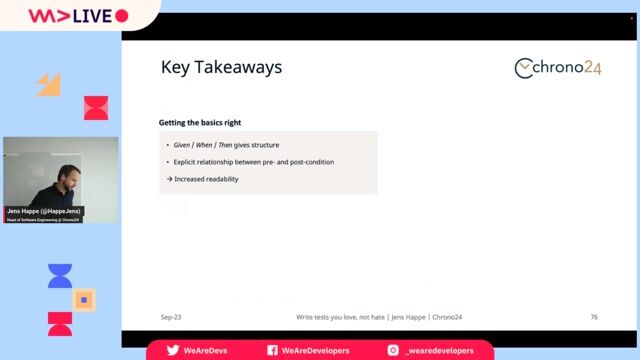
Summary of key principles for better testing
Write tests you love, not hate
Unlock Moments
Create a free account to watch a limited number of Moments each month.
Upgrade to PRO for unlimited access to the full archive.
Upgrade to PRO for unlimited access to the full archive.
You have an account? Log in

05:52 MIN
Architectural trade-offs and testing strategies
Interface Contracts in Microfrontend Architectures
Unlock Moments
Create a free account to watch a limited number of Moments each month.
Upgrade to PRO for unlimited access to the full archive.
Upgrade to PRO for unlimited access to the full archive.
You have an account? Log in

03:12 MIN
Focusing on return on investment for tests
Why I Love End-2-End Tests and How To Get Them Right
Unlock Moments
Create a free account to watch a limited number of Moments each month.
Upgrade to PRO for unlimited access to the full archive.
Upgrade to PRO for unlimited access to the full archive.
You have an account? Log in

04:45 MIN
Why traditional testing methods fail for microservice architectures
Lessons from Our API Past: Evolving to a Resilient API Future
Unlock Moments
Create a free account to watch a limited number of Moments each month.
Upgrade to PRO for unlimited access to the full archive.
Upgrade to PRO for unlimited access to the full archive.
You have an account? Log in
Featured Partners
Related Videos
 23:40
23:40Test-reduction - Doing more with less
Ewald Verhoeven
 26:33
26:33How Unit Testing Saved My Career
Annelore Egger
 43:07
43:07How not to test
Golo Roden
 26:20
26:20How to add test automation to your project: The good, the bad, and the ugly
Augustin Gottlieb
 56:49
56:49Write tests you love, not hate
Jens Happe
 24:19
24:19It's a (testing) trap! - Common testing pitfalls and how to solve them
Ramona Schwering
 23:46
23:46Why I Love End-2-End Tests and How To Get Them Right
Johannes Stern
 28:33
28:33The 2025 State of JavaScript Testing
Daniel Afonso
Related Articles
View all articles



From learning to earning
Jobs that call for the skills explored in this talk.


Think-cell
Foster City, United States of America
Intermediate
Unit Testing
Manual Testing
Automated Testing


Vesterling Consulting GmbH
Vesterling Consulting GmbH
Vesterling Consulting GmbH
Vesterling Consulting GmbH
Vesterling Consulting GmbH
Vesterling Consulting GmbH