David Leitner
The Rise of Reactive Microservices
#1about 3 minutes
The pitfalls of synchronous microservice communication
Synchronous calls between services create tight coupling and lead to cascading failures when downstream systems experience latency.
#2about 4 minutes
Decoupling services with asynchronous message queues
Using message queues like RabbitMQ isolates high-latency services and improves system resilience by changing from immediate creation to eventual acceptance.
#3about 4 minutes
Avoiding the entity service anti-pattern in architecture
Slicing microservices based on data entities like 'user' or 'account' creates dependencies across teams and slows down feature development.
#4about 7 minutes
Using push-based streams for data synchronization
Reactive systems push data changes through event streams, allowing services to build local read models (projections) and achieve runtime autonomy.
#5about 7 minutes
Navigating the challenges of eventual consistency
Eventual consistency involves three main challenges—divergence, variance, and latency—which can be managed with ordering, deduplication, and optimistic UIs.
#6about 5 minutes
The key benefits of building reactive systems
Reactive architectures improve resilience and enable horizontal scaling by creating autonomous services that can build real-time, push-based user interfaces.
#7about 2 minutes
Decomposing monoliths with change data capture
Change Data Capture (CDC) streams events directly from a legacy database's transaction log, enabling gradual monolith decomposition without modifying the legacy code.
#8about 6 minutes
Achieving massive throughput with sharded architectures
Sharding partitions data and processing across independent streams, enabling systems to scale horizontally and handle nearly unlimited throughput.
#9about 3 minutes
Balancing architectural complexity and business needs
Evolving from a monolith to a sharded, stream-based system adds powerful capabilities but also increases complexity, so always choose the simplest architecture that meets your requirements.
#10about 3 minutes
Answering questions on micro-frontends and data ownership
The speaker discusses how micro-frontends align with team autonomy and clarifies that while data can be copied to projections, updates must go through the owning service.
Related jobs
Jobs that call for the skills explored in this talk.


Matching moments
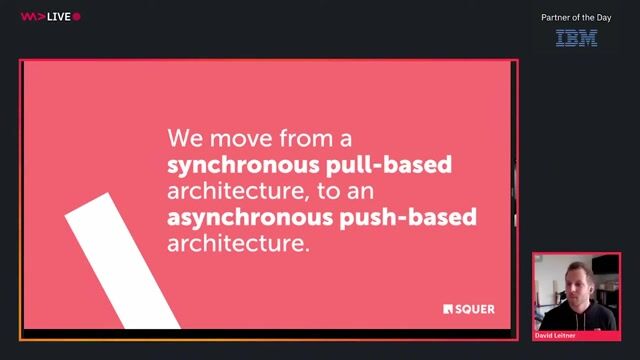
07:20 MIN
Tracing the evolution of microservices toward reactivity
Rethinking Reactive Architectures with GraphQL
Unlock Moments
Create a free account to watch a limited number of Moments each month.
Upgrade to PRO for unlimited access to the full archive.
Upgrade to PRO for unlimited access to the full archive.
You have an account? Log in
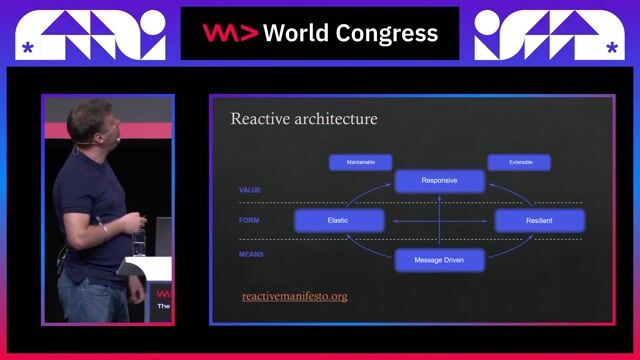
01:32 MIN
Understanding the principles of reactive architecture
Architectures that we can use with .NET
Unlock Moments
Create a free account to watch a limited number of Moments each month.
Upgrade to PRO for unlimited access to the full archive.
Upgrade to PRO for unlimited access to the full archive.
You have an account? Log in
08:28 MIN
Applying reactive principles to system architecture
Rethinking Reactive Architectures with GraphQL
Unlock Moments
Create a free account to watch a limited number of Moments each month.
Upgrade to PRO for unlimited access to the full archive.
Upgrade to PRO for unlimited access to the full archive.
You have an account? Log in
05:40 MIN
Evolving from classic microservices to event-driven design
Kafka Streams Microservices
Unlock Moments
Create a free account to watch a limited number of Moments each month.
Upgrade to PRO for unlimited access to the full archive.
Upgrade to PRO for unlimited access to the full archive.
You have an account? Log in
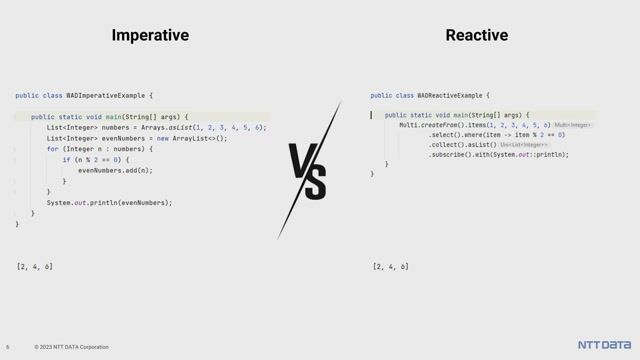
02:07 MIN
Meeting modern application demands with the Reactive Manifesto
Is reactive the new black? Imperative vs. reactive programming with Quarkus
Unlock Moments
Create a free account to watch a limited number of Moments each month.
Upgrade to PRO for unlimited access to the full archive.
Upgrade to PRO for unlimited access to the full archive.
You have an account? Log in
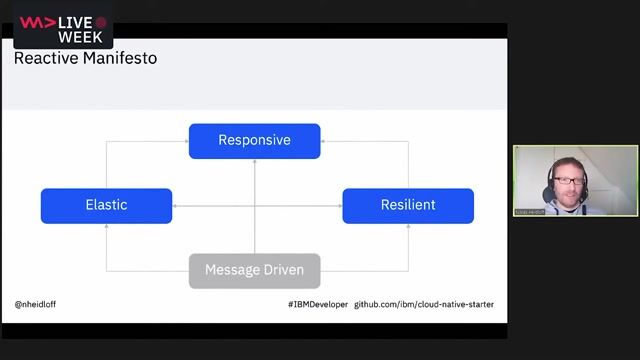
02:23 MIN
Core principles of the reactive manifesto
Development of reactive applications with Quarkus
Unlock Moments
Create a free account to watch a limited number of Moments each month.
Upgrade to PRO for unlimited access to the full archive.
Upgrade to PRO for unlimited access to the full archive.
You have an account? Log in
05:37 MIN
Understanding the core principles of the reactive manifesto
Side-by-Side: Reactive vs non-reactive Java
Unlock Moments
Create a free account to watch a limited number of Moments each month.
Upgrade to PRO for unlimited access to the full archive.
Upgrade to PRO for unlimited access to the full archive.
You have an account? Log in
06:43 MIN
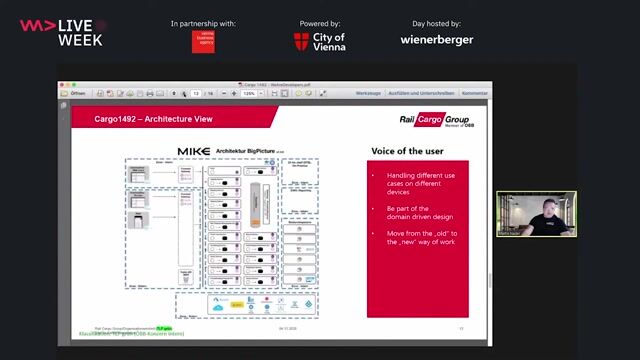
Building an event-based microservice architecture for agility
The user in the eye of the Cargo1492 storm
Unlock Moments
Create a free account to watch a limited number of Moments each month.
Upgrade to PRO for unlimited access to the full archive.
Upgrade to PRO for unlimited access to the full archive.
You have an account? Log in
Featured Partners
Related Videos
 41:06
41:06Rethinking Reactive Architectures with GraphQL
David Leitner
 43:27
43:27CQRS and Event Sourcing without the pixie dust
Allard Buijze
 28:12
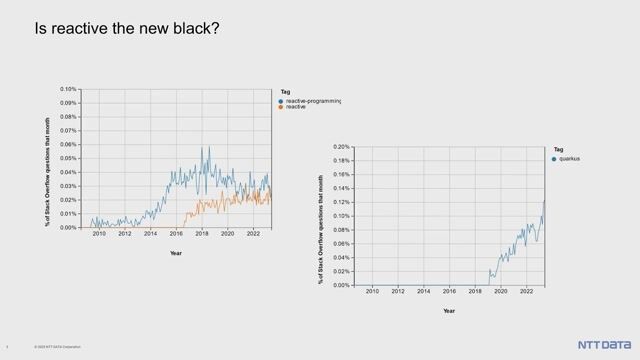
28:12Is reactive the new black? Imperative vs. reactive programming with Quarkus
Tatiana Chervova
 43:13
43:13It’s all about the domain, honey ! Experiences from 15 years of Domain-Driven Design
Carola Lilienthal
 58:23
58:23Building high performance and scalable architectures for enterprises
Luka Samaržija & Ivan Sokol
 40:17
40:17Micro-frontends anti-patterns
Luca Mezzalira
 45:48
45:48Kafka Streams Microservices
Denis Washington & Olli Salonen
 43:20
43:20Microfrontends at Scale
Josh Goldberg
Related Articles
View all articles.gif?w=240&auto=compress,format)



From learning to earning
Jobs that call for the skills explored in this talk.



M&M Software GmbH
Sankt Georgen im Schwarzwald, Germany
Intermediate
Senior
Docker

CONTIAMO GMBH
Berlin, Germany
Senior
Python
Docker
TypeScript
PostgreSQL

Peter Park System GmbH
München, Germany
Senior
Python
Docker
Node.js
JavaScript





Speech Processing Solutions
Vienna, Austria
Intermediate
CSS
HTML
JavaScript
TypeScript