Luca Mezzalira
Micro-frontends anti-patterns
#1about 3 minutes
Understanding the core benefits of micro-frontend architecture
Micro-frontends enable incremental upgrades, decentralized decision-making, reduced team cognitive load, and scalable organizational structures.
#2about 5 minutes
Anti-pattern: Confusing micro-frontends with reusable components
A micro-frontend represents a business sub-domain and is independently deployable, whereas a component has its behavior dictated by its container.
#3about 2 minutes
Anti-pattern: Using a multi-framework approach incorrectly
While technically possible, using multiple frameworks should be reserved for temporary situations like migrating legacy systems, not for developer preference.
#4about 5 minutes
Anti-pattern: Using an anti-corruption layer for legacy systems
Instead of adding complex, one-off logic to the main application shell, wrap legacy code in a dedicated micro-frontend that acts as an anti-corruption layer.
#5about 4 minutes
Anti-pattern: The risks of shared core libraries
Creating shared core libraries can lead to versioning conflicts and deployment coupling, so prefer composition over inheritance to minimize these risks.
#6about 3 minutes
Anti-pattern: Adopting unidirectional data flow for easier debugging
Bi-directional data sharing between a host and micro-frontends creates complexity, while unidirectional data flow patterns like Flux make state changes predictable.
#7about 2 minutes
Anti-pattern: Avoiding tight coupling with event-based communication
Using a shared global state creates tight design-time coupling between teams; a publish-subscribe (pub/sub) event system enables loosely coupled communication.
#8about 4 minutes
Anti-pattern: Analyzing the backend impact of frontend architecture
When multiple micro-frontends call the same API, it may indicate overlapping domains and cause unnecessary backend load, so consider merging them or using components.
#9about 4 minutes
Viewing software architecture as a series of trade-offs
Architectural decisions are not right or wrong but are based on context-specific trade-offs that should be documented using tools like Architectural Decision Records (ADRs).
#10about 8 minutes
Q&A: MFE communication, monorepos, and appropriate use cases
The discussion covers preferred methods for MFE-to-MFE communication, the trade-offs between monorepos and multi-repos, and when micro-frontends are an appropriate choice.
Related jobs
Jobs that call for the skills explored in this talk.


Matching moments
03:17 MIN
A brief history of the micro-frontend architectural pattern
Micro-frontends anti-patterns
Unlock Moments
Create a free account to watch a limited number of Moments each month.
Upgrade to PRO for unlimited access to the full archive.
Upgrade to PRO for unlimited access to the full archive.
You have an account? Log in
02:03 MIN
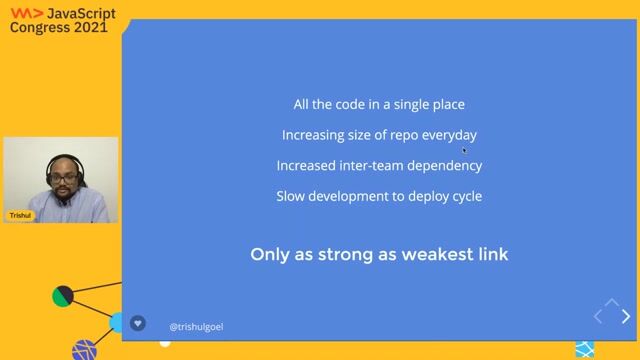
Introducing the micro-frontend architectural pattern
Destructuring Frontend monoliths with MicroFrontends
Unlock Moments
Create a free account to watch a limited number of Moments each month.
Upgrade to PRO for unlimited access to the full archive.
Upgrade to PRO for unlimited access to the full archive.
You have an account? Log in
03:02 MIN
Understanding the key benefits of micro-frontend architecture
Micro-frontends anti-patterns
Unlock Moments
Create a free account to watch a limited number of Moments each month.
Upgrade to PRO for unlimited access to the full archive.
Upgrade to PRO for unlimited access to the full archive.
You have an account? Log in

01:49 MIN
Micro frontends are an organizational pattern for scaling teams
Multiple Ships to the Island - Micro Frontends & Island Architectures
Unlock Moments
Create a free account to watch a limited number of Moments each month.
Upgrade to PRO for unlimited access to the full archive.
Upgrade to PRO for unlimited access to the full archive.
You have an account? Log in
04:34 MIN
Conclusion and key takeaways on micro frontends
Micro Frontends with Module Federation: Why and How?
Unlock Moments
Create a free account to watch a limited number of Moments each month.
Upgrade to PRO for unlimited access to the full archive.
Upgrade to PRO for unlimited access to the full archive.
You have an account? Log in
02:27 MIN
Understanding the core challenge of micro frontend integration
Native Federation: The Future of Micro Frontends and Plugin-Systems in Angular
Unlock Moments
Create a free account to watch a limited number of Moments each month.
Upgrade to PRO for unlimited access to the full archive.
Upgrade to PRO for unlimited access to the full archive.
You have an account? Log in
02:43 MIN
Common challenges and implementation drawbacks
Micro Frontends with Module Federation: Why and How?
Unlock Moments
Create a free account to watch a limited number of Moments each month.
Upgrade to PRO for unlimited access to the full archive.
Upgrade to PRO for unlimited access to the full archive.
You have an account? Log in

06:11 MIN
Tracing the architectural evolution to microfrontends
Microfrontends with Blazor: Welcome to the Party!
Unlock Moments
Create a free account to watch a limited number of Moments each month.
Upgrade to PRO for unlimited access to the full archive.
Upgrade to PRO for unlimited access to the full archive.
You have an account? Log in
Featured Partners
Related Videos
 47:05
47:05Micro-frontends anti-patterns
Luca Mezzalira
 45:40
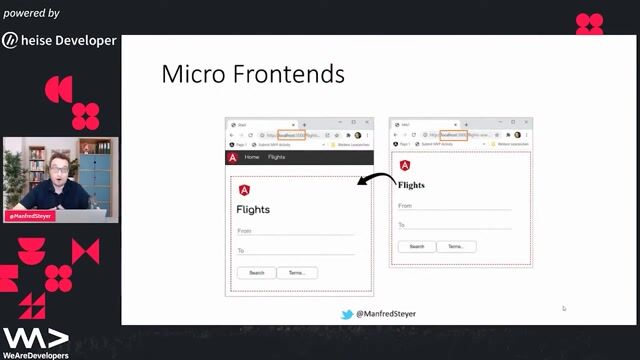
45:40Micro Frontends with Module Federation: Why and How?
Manfred Steyer
 43:20
43:20Microfrontends at Scale
Josh Goldberg
 59:03
59:03Multiple Ships to the Island - Micro Frontends & Island Architectures
Florian Rappl
 54:39
54:39Interface Contracts in Microfrontend Architectures
Alexander Günsche
 40:05
40:05Stairway to Heaven - Scaling Frontends the Right Way
Florian Rappl
 44:35
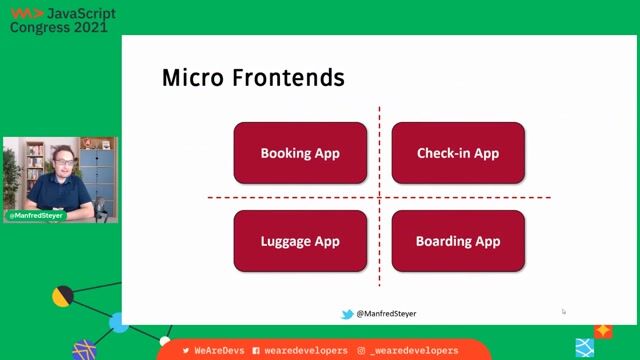
44:35Micro-Frontends with Module Federation: Beyond the Basics
Manfred Steyer
 41:49
41:49Destructuring Frontend monoliths with MicroFrontends
Trishul Goel
Related Articles
View all articles.gif?w=240&auto=compress,format)



From learning to earning
Jobs that call for the skills explored in this talk.


Speech Processing Solutions
Vienna, Austria
Intermediate
CSS
HTML
JavaScript
TypeScript


JO Media Software Solutions GmBh
Brunn am Gebirge, Austria
Senior
CSS
Angular
JavaScript
TypeScript


infomax websolutions GmbH
Grassau, Germany
Intermediate
Senior
CSS
HTML
JavaScript
TypeScript

Peter Park System GmbH
München, Germany
Senior
Python
Docker
Node.js
JavaScript

doinstruct Software GmbH
Berlin, Germany
Senior
GIT
JavaScript
TypeScript





Saby New Compy
Bielefeld, Germany
Intermediate
Java
Kotlin