Manfred Steyer
Micro Frontends with Module Federation: Why and How?
#1about 3 minutes
Software architecture is about evaluating consequences
Software architecture is not about finding the single best solution, but about evaluating the consequences of different approaches for your specific situation.
#2about 1 minute
Understanding the micro frontend architectural style
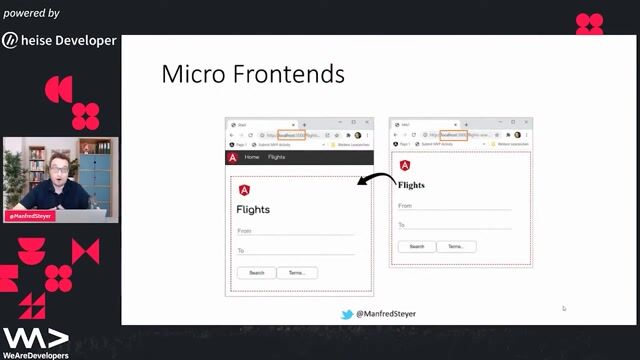
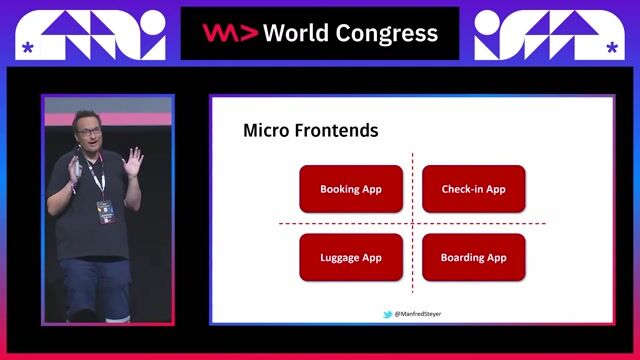
Micro frontends break down a large application into smaller, independently developed and deployed parts that are integrated into a common shell at runtime.
#3about 5 minutes
Exploring real-world use cases for micro frontends
Case studies from healthcare, payroll, and banking illustrate how large organizations use micro frontends to manage complexity across different business domains.
#4about 3 minutes
The primary reasons for adopting micro frontends
The main drivers for adopting micro frontends are scaling development across multiple teams, enabling long-term technology evolution, and quickly adapting to changing requirements.
#5about 3 minutes
Common challenges and implementation drawbacks
Implementing micro frontends introduces challenges such as the effort to build an orchestration layer, difficulties in sharing code at runtime, and maintaining a consistent user experience.
#6about 5 minutes
How Module Federation enables runtime integration
Module Federation, a Webpack 5 feature, allows a host application to dynamically load code from a separately compiled remote application, solving a key challenge for micro frontends.
#7about 2 minutes
Sharing libraries and handling version conflicts
Module Federation simplifies sharing common libraries like Angular or React to reduce bundle sizes and includes built-in strategies to manage potential version mismatches between micro frontends.
#8about 5 minutes
Live demo: Initial setup with an Angular plugin
A live demonstration shows how to use an Angular CLI plugin to quickly add the necessary builders and initial Webpack configuration for Module Federation to a project.
#9about 6 minutes
Live demo: Configuring the host and remote
The Webpack configuration is adjusted to expose a module from the remote micro frontend and define the remote's URL in the host shell application for lazy loading.
#10about 4 minutes
Implementing dynamic federation at runtime
The implementation is refactored from static federation to dynamic federation, allowing the application to determine which micro frontends to load at runtime from a backend configuration.
#11about 4 minutes
Combining Module Federation with Web Components
Using Web Components with Module Federation allows for mixing different frameworks and versions in one application, but requires careful handling to avoid conflicts.
#12about 5 minutes
Conclusion and key takeaways on micro frontends
Micro frontends are primarily a solution for scaling teams and domains, and while they introduce runtime dependencies, Module Federation provides a straightforward implementation path.
Related jobs
Jobs that call for the skills explored in this talk.


Matching moments
05:24 MIN
The role of micro-frontends in scaling development teams
Micro-Frontends with Module Federation: Beyond the Basics
Unlock Moments
Create a free account to watch a limited number of Moments each month.
Upgrade to PRO for unlimited access to the full archive.
Upgrade to PRO for unlimited access to the full archive.
You have an account? Log in
13:10 MIN
Audience Q&A on practical micro-frontend challenges
Micro-frontends anti-patterns
Unlock Moments
Create a free account to watch a limited number of Moments each month.
Upgrade to PRO for unlimited access to the full archive.
Upgrade to PRO for unlimited access to the full archive.
You have an account? Log in
02:57 MIN
Integrating micro frontends with module federation
Advanced Micro Frontends: Multi-Version and Multi-Framework Scenarios
Unlock Moments
Create a free account to watch a limited number of Moments each month.
Upgrade to PRO for unlimited access to the full archive.
Upgrade to PRO for unlimited access to the full archive.
You have an account? Log in
04:47 MIN
Using Webpack 5 Module Federation for micro frontends
Front-End Micro Apps
Unlock Moments
Create a free account to watch a limited number of Moments each month.
Upgrade to PRO for unlimited access to the full archive.
Upgrade to PRO for unlimited access to the full archive.
You have an account? Log in
01:31 MIN
Key takeaways and resources for further learning
The Microfrontend Revolution- Using Webpack 5 Module Federation with Angular
Unlock Moments
Create a free account to watch a limited number of Moments each month.
Upgrade to PRO for unlimited access to the full archive.
Upgrade to PRO for unlimited access to the full archive.
You have an account? Log in
04:06 MIN
The historical challenge of building micro frontends
The Microfrontend Revolution- Using Webpack 5 Module Federation with Angular
Unlock Moments
Create a free account to watch a limited number of Moments each month.
Upgrade to PRO for unlimited access to the full archive.
Upgrade to PRO for unlimited access to the full archive.
You have an account? Log in
01:34 MIN
Key takeaways for building multi-version frontends
Advanced Micro Frontends: Multi-Version and Multi-Framework Scenarios
Unlock Moments
Create a free account to watch a limited number of Moments each month.
Upgrade to PRO for unlimited access to the full archive.
Upgrade to PRO for unlimited access to the full archive.
You have an account? Log in
08:25 MIN
Loading micro-frontends with dynamic federation
Micro-Frontends with Module Federation: Beyond the Basics
Unlock Moments
Create a free account to watch a limited number of Moments each month.
Upgrade to PRO for unlimited access to the full archive.
Upgrade to PRO for unlimited access to the full archive.
You have an account? Log in
Featured Partners
Related Videos
 44:35
44:35Micro-Frontends with Module Federation: Beyond the Basics
Manfred Steyer
 33:18
33:18The Microfrontend Revolution- Using Webpack 5 Module Federation with Angular
Manfred Steyer
 24:47
24:47Advanced Micro Frontends: Multi-Version and Multi-Framework Scenarios
Manfred Steyer
 29:36
29:36Native Federation: The Future of Micro Frontends and Plugin-Systems in Angular
Manfred Steyer
 35:17
35:17Front-End Micro Apps
Serg Hospodarets
 43:20
43:20Microfrontends at Scale
Josh Goldberg
 40:05
40:05Stairway to Heaven - Scaling Frontends the Right Way
Florian Rappl
 40:17
40:17Micro-frontends anti-patterns
Luca Mezzalira
Related Articles
View all articles
.gif?w=240&auto=compress,format)

.png?w=240&auto=compress,format)
From learning to earning
Jobs that call for the skills explored in this talk.


Speech Processing Solutions
Vienna, Austria
Intermediate
CSS
HTML
JavaScript
TypeScript


JO Media Software Solutions GmBh
Brunn am Gebirge, Austria
Senior
CSS
Angular
JavaScript
TypeScript


BMS Corporate Solutions GmbH
Düsseldorf, Germany
Intermediate
Senior
CSS
HTML
Angular
TypeScript

infomax websolutions GmbH
Grassau, Germany
Intermediate
Senior
CSS
HTML
JavaScript
TypeScript

doinstruct Software GmbH
Berlin, Germany
Senior
GIT
JavaScript
TypeScript


norisk Group
München, Germany
Intermediate
Senior
Nuxt.js
JavaScript

autoiXpert GmbH & Co. KG
Stuttgart, Germany
Senior
Node.js
Angular
MongoDB
TypeScript

Peter Park System GmbH
München, Germany
Senior
Python
Docker
Node.js
JavaScript