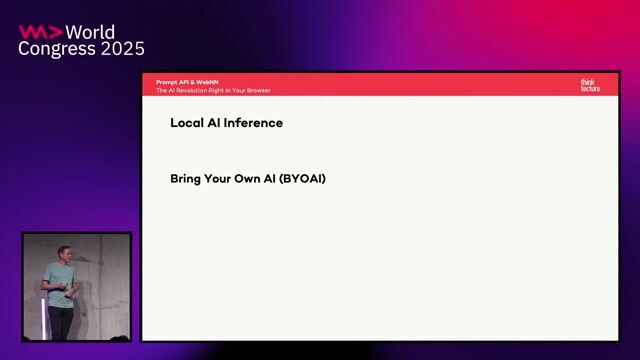
Christian Liebel
Prompt API & WebNN: The AI Revolution Right in Your Browser
#1about 3 minutes
The case for running AI models locally
Cloud-based AI has drawbacks like offline limitations, capacity issues, data privacy concerns, and subscription costs, creating an opportunity for local, on-device models.
#2about 2 minutes
Two primary approaches for browser-based AI
The W3C is exploring two main approaches for on-device AI: "Bring Your Own AI" libraries like WebLLM and low-level APIs like WebNN, alongside experimental "Built-in AI" APIs like the Prompt API.
#3about 3 minutes
Running large language models with WebLLM
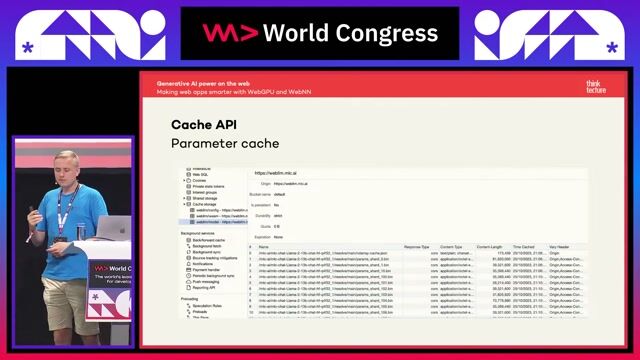
The WebLLM library uses WebGPU to download and run open-weight large language models directly in the browser's cache storage, enabling offline chat and data processing.
#4about 1 minute
Solving the model size and storage problem
Large AI models create a storage problem due to browser origin isolation, leading to a proposal for a Cross Origin Storage API to allow models to be shared across different websites.
#5about 2 minutes
Exploring diverse ML workloads with Transformers.js
The Transformers.js library enables various on-device machine learning tasks beyond text generation, such as computer vision and audio processing, as shown in a sketch recognition game.
#6about 4 minutes
Accelerating performance with the WebNN API
The upcoming Web Neural Network (WebNN) API provides direct access to specialized hardware like NPUs, offering a significant performance increase for ML tasks compared to CPU or GPU processing.
#7about 3 minutes
The alternative: Built-in AI and the Prompt API
Google Chrome's experimental built-in AI initiative solves model sharing and performance issues by providing standardized APIs that use a single, browser-managed model like Gemini Nano.
#8about 4 minutes
Exploring the built-in AI API suite
A demonstration of the built-in AI APIs shows how to use the summarizer, language detector, and Prompt API for general LLM tasks directly from JavaScript in the browser.
#9about 4 minutes
Practical use cases for on-device AI
On-device AI can enhance web applications with features like an offline-capable chatbot in an Angular app or a smart form filler that automatically categorizes and inputs user data.
#10about 3 minutes
Building real-time conversational agents
Demonstrations of a multimodal insurance form assistant and a simple on-device conversational agent highlight the potential for creating interactive, real-time user experiences with local AI.
#11about 1 minute
Weighing the pros and cons of on-device AI
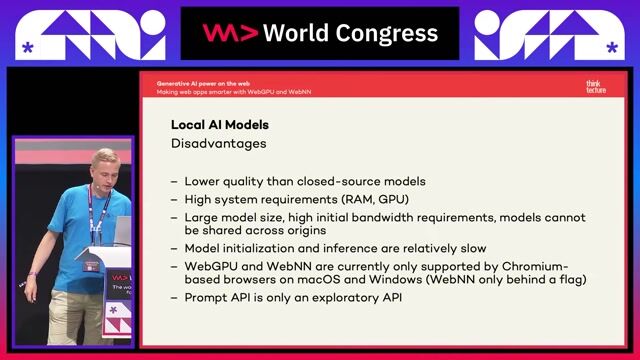
On-device AI offers significant advantages in privacy, availability, and cost, but developers must consider the trade-offs in model capability, response quality, and system requirements compared to cloud solutions.
Related jobs
Jobs that call for the skills explored in this talk.


Matching moments
03:24 MIN
Running on-device AI in the browser with Gemini Nano
Exploring Google Gemini and Generative AI
Unlock Moments
Create a free account to watch a limited number of Moments each month.
Upgrade to PRO for unlimited access to the full archive.
Upgrade to PRO for unlimited access to the full archive.
You have an account? Log in
01:14 MIN
The future of on-device AI in web development
Generative AI power on the web: making web apps smarter with WebGPU and WebNN
Unlock Moments
Create a free account to watch a limited number of Moments each month.
Upgrade to PRO for unlimited access to the full archive.
Upgrade to PRO for unlimited access to the full archive.
You have an account? Log in

02:08 MIN
The future of on-device AI hardware and APIs
From ML to LLM: On-device AI in the Browser
Unlock Moments
Create a free account to watch a limited number of Moments each month.
Upgrade to PRO for unlimited access to the full archive.
Upgrade to PRO for unlimited access to the full archive.
You have an account? Log in
02:20 MIN
The technology behind in-browser AI execution
Generative AI power on the web: making web apps smarter with WebGPU and WebNN
Unlock Moments
Create a free account to watch a limited number of Moments each month.
Upgrade to PRO for unlimited access to the full archive.
Upgrade to PRO for unlimited access to the full archive.
You have an account? Log in
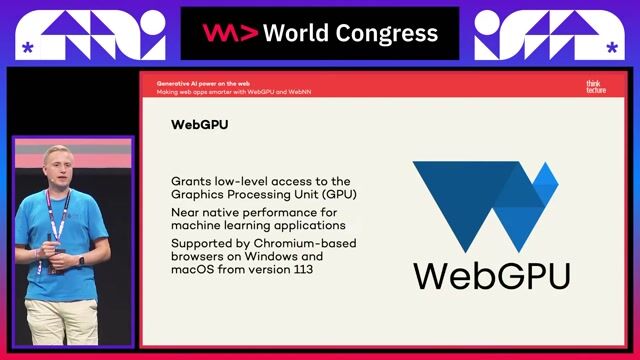
03:35 MIN
Boosting performance with the upcoming WebNN API
Generative AI power on the web: making web apps smarter with WebGPU and WebNN
Unlock Moments
Create a free account to watch a limited number of Moments each month.
Upgrade to PRO for unlimited access to the full archive.
Upgrade to PRO for unlimited access to the full archive.
You have an account? Log in
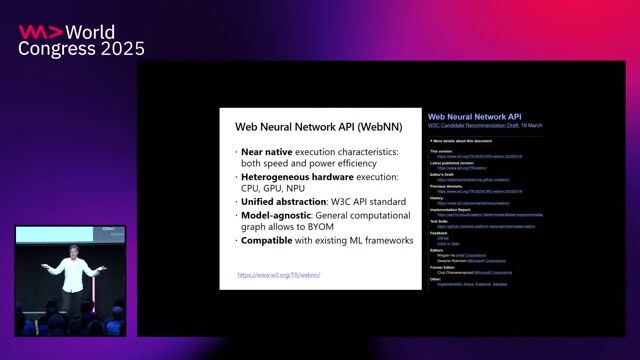
02:51 MIN
Introducing the Web Neural Network (WebNN) standard
Privacy-first in-browser Generative AI web apps: offline-ready, future-proof, standards-based
Unlock Moments
Create a free account to watch a limited number of Moments each month.
Upgrade to PRO for unlimited access to the full archive.
Upgrade to PRO for unlimited access to the full archive.
You have an account? Log in
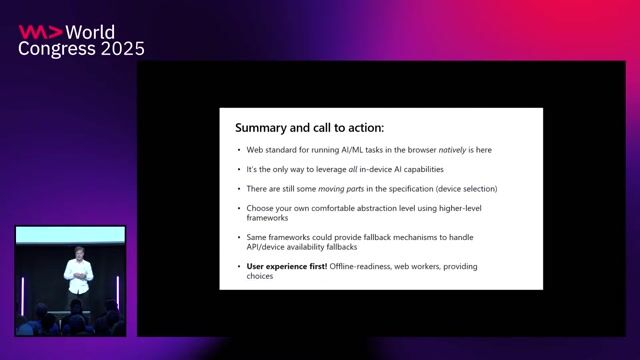
03:28 MIN
Best practices and the future of browser AI
Privacy-first in-browser Generative AI web apps: offline-ready, future-proof, standards-based
Unlock Moments
Create a free account to watch a limited number of Moments each month.
Upgrade to PRO for unlimited access to the full archive.
Upgrade to PRO for unlimited access to the full archive.
You have an account? Log in
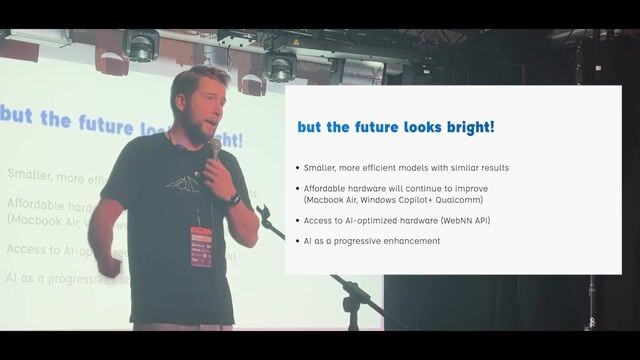
01:55 MIN
Key benefits of running AI in the browser
From ML to LLM: On-device AI in the Browser
Unlock Moments
Create a free account to watch a limited number of Moments each month.
Upgrade to PRO for unlimited access to the full archive.
Upgrade to PRO for unlimited access to the full archive.
You have an account? Log in
Featured Partners
Related Videos
 32:27
32:27Generative AI power on the web: making web apps smarter with WebGPU and WebNN
Christian Liebel
 30:13
30:13Privacy-first in-browser Generative AI web apps: offline-ready, future-proof, standards-based
Maxim Salnikov
 27:23
27:23From ML to LLM: On-device AI in the Browser
Nico Martin
 33:51
33:51Exploring the Future of Web AI with Google
Thomas Steiner
 25:47
25:47Performant Architecture for a Fast Gen AI User Experience
Nathaniel Okenwa
 25:17
25:17AI: Superhero or Supervillain? How and Why with Scott Hanselman
Scott Hanselman
 32:26
32:26Bringing the power of AI to your application.
Krzysztof Cieślak
 31:12
31:12Using LLMs in your Product
Daniel Töws
Related Articles
View all articles



From learning to earning
Jobs that call for the skills explored in this talk.




Speech Processing Solutions
Vienna, Austria
Intermediate
CSS
HTML
JavaScript
TypeScript


Conrad Electronic SE
webLyzard
Vienna, Austria
DevOps
Docker
PostgreSQL
Kubernetes
Elasticsearch
+2
RE-INvent Retail GmbH
Microservices