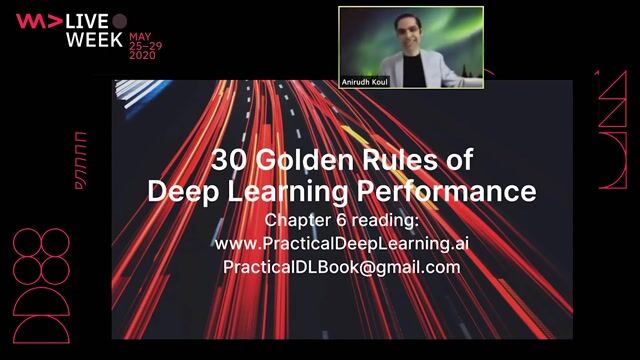
Anirudh Koul
30 Golden Rules of Deep Learning Performance
#1about 5 minutes
The high cost of waiting for deep learning models to train
Long training times are a major bottleneck for developers, wasting both time and hardware resources.
#2about 2 minutes
Fine-tune your existing hardware instead of buying more GPUs
Instead of simply buying more expensive hardware, you can achieve significant performance gains by optimizing your existing setup.
#3about 3 minutes
Using transfer learning to accelerate model development
Transfer learning provides a powerful baseline by fine-tuning pre-trained models for specific tasks, drastically reducing training time.
#4about 4 minutes
Diagnose GPU starvation using profiling tools
Use tools like the TensorBoard Profiler and nvidia-smi to identify when your GPU is idle and waiting for data from the CPU.
#5about 3 minutes
Prepare your data efficiently before training begins
Optimize data preparation by serializing data into moderately sized files, pre-computing transformations, and leveraging TensorFlow Datasets for high-performance pipelines.
#6about 5 minutes
Construct a high-performance input pipeline with tf.data
Use the tf.data API to build an efficient data reading pipeline by implementing prefetching, parallelization, caching, and autotuning.
#7about 3 minutes
Move data augmentation from the CPU to the GPU
Avoid CPU bottlenecks by performing data augmentation directly on the GPU using either TensorFlow's built-in functions or the NVIDIA DALI library.
#8about 5 minutes
Key optimizations for the model training loop
Speed up the training loop by enabling mixed-precision training, maximizing the batch size, and using multiples of eight to leverage specialized hardware like Tensor Cores.
#9about 2 minutes
Automatically find the optimal learning rate for faster convergence
Use a learning rate finder library to systematically identify the optimal learning rate, preventing slow convergence or overshooting the solution.
#10about 2 minutes
Compile Python code into a graph with the tf.function decorator
Gain a significant performance boost by using the @tf.function decorator to compile eager-mode TensorFlow code into an optimized computation graph.
#11about 2 minutes
Use progressive sizing and curriculum learning strategies
Accelerate training by starting with smaller image resolutions and simpler tasks, then progressively increasing complexity as the model learns.
#12about 3 minutes
Optimize your environment and scale up your hardware
Install hardware-specific binaries and leverage distributed training strategies to scale your jobs across multiple GPUs on-premise or in the cloud.
#13about 3 minutes
Learn from cost-effective and high-speed training benchmarks
Analyze benchmarks like DawnBench and MLPerf to adopt strategies for training models faster and more cost-effectively by leveraging optimized cloud resources.
#14about 3 minutes
Select efficient model architectures for fast inference
For production deployment, choose lightweight yet accurate model architectures like MobileNet, EfficientDet, or DistilBERT to ensure fast inference on end-user devices.
#15about 2 minutes
Shrink model size and improve speed with quantization
Use model quantization to convert 32-bit weights to 8-bit integers, significantly reducing the model's size and memory footprint for faster inference.
Related jobs
Jobs that call for the skills explored in this talk.


Matching moments
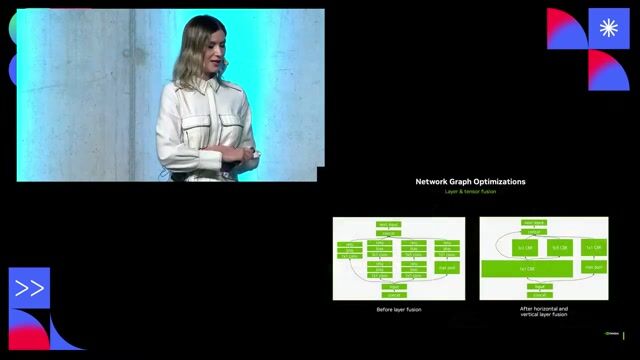
03:36 MIN
Advanced techniques for boosting inference performance
Trends, Challenges and Best Practices for AI at the Edge
Unlock Moments
Create a free account to watch a limited number of Moments each month.
Upgrade to PRO for unlimited access to the full archive.
Upgrade to PRO for unlimited access to the full archive.
You have an account? Log in

01:52 MIN
Summary of key performance optimization techniques
Performant Architecture for a Fast Gen AI User Experience
Unlock Moments
Create a free account to watch a limited number of Moments each month.
Upgrade to PRO for unlimited access to the full archive.
Upgrade to PRO for unlimited access to the full archive.
You have an account? Log in

03:36 MIN
Strategies to overcome deep learning limitations
The pitfalls of Deep Learning - When Neural Networks are not the solution
Unlock Moments
Create a free account to watch a limited number of Moments each month.
Upgrade to PRO for unlimited access to the full archive.
Upgrade to PRO for unlimited access to the full archive.
You have an account? Log in
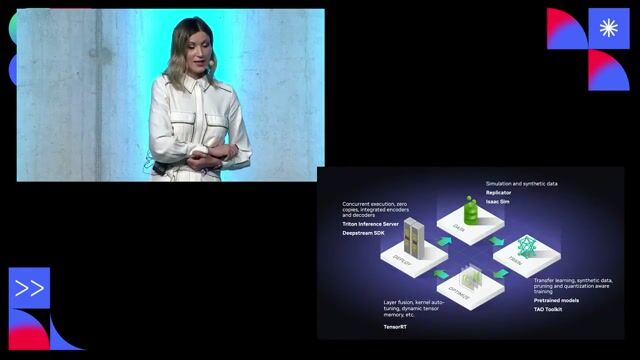
02:23 MIN
Matching edge AI challenges with NVIDIA's solutions
Trends, Challenges and Best Practices for AI at the Edge
Unlock Moments
Create a free account to watch a limited number of Moments each month.
Upgrade to PRO for unlimited access to the full archive.
Upgrade to PRO for unlimited access to the full archive.
You have an account? Log in
05:12 MIN
Boosting Python performance with the Nvidia CUDA ecosystem
The weekly developer show: Boosting Python with CUDA, CSS Updates & Navigating New Tech Stacks
Unlock Moments
Create a free account to watch a limited number of Moments each month.
Upgrade to PRO for unlimited access to the full archive.
Upgrade to PRO for unlimited access to the full archive.
You have an account? Log in
01:30 MIN
Overlooked challenges of running AI applications in production
Chatbots are going to destroy infrastructures and your cloud bills
Unlock Moments
Create a free account to watch a limited number of Moments each month.
Upgrade to PRO for unlimited access to the full archive.
Upgrade to PRO for unlimited access to the full archive.
You have an account? Log in
03:25 MIN
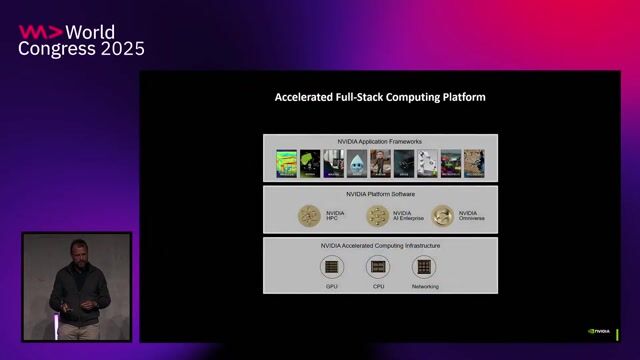
Achieving massive energy efficiency in AI compute
Pioneering AI Assistants in Banking
Unlock Moments
Create a free account to watch a limited number of Moments each month.
Upgrade to PRO for unlimited access to the full archive.
Upgrade to PRO for unlimited access to the full archive.
You have an account? Log in
06:21 MIN
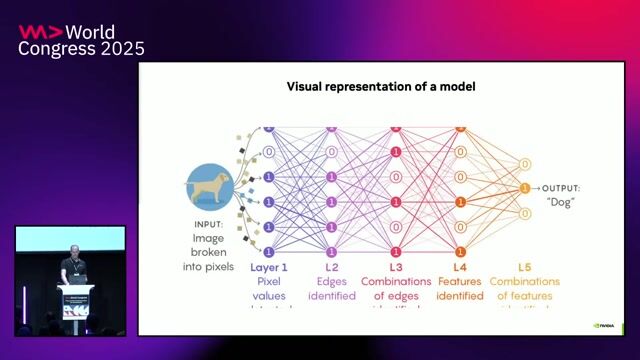
Understanding parallelism techniques for distributed AI training
Your Next AI Needs 10,000 GPUs. Now What?
Unlock Moments
Create a free account to watch a limited number of Moments each month.
Upgrade to PRO for unlimited access to the full archive.
Upgrade to PRO for unlimited access to the full archive.
You have an account? Log in
Featured Partners
Related Videos
 57:46
57:46Overview of Machine Learning in Python
Adrian Schmitt
 59:43
59:43Accelerating Python on GPUs
Paul Graham
 22:07
22:07WWC24 - Ankit Patel - Unlocking the Future Breakthrough Application Performance and Capabilities with NVIDIA
Ankit Patel
 35:16
35:16How AI Models Get Smarter
Ankit Patel
 32:54
32:54The pitfalls of Deep Learning - When Neural Networks are not the solution
Adrian Spataru & Bohdan Andrusyak
 27:23
27:23From ML to LLM: On-device AI in the Browser
Nico Martin
 57:49
57:49Vectorize all the things! Using linear algebra and NumPy to make your Python code lightning fast.
Jodie Burchell
 38:24
38:24Machine learning in the browser with TensorFlowjs
Håkan Silfvernagel
Related Articles
View all articles
.gif?w=240&auto=compress,format)


From learning to earning
Jobs that call for the skills explored in this talk.


CONTIAMO GMBH
Berlin, Germany
Senior
Python
Docker
TypeScript
PostgreSQL

Peter Park System GmbH
München, Germany
Senior
Python
Docker
Node.js
JavaScript

SYSKRON GmbH
Regensburg, Germany
Intermediate
Senior
.NET
Python
Kubernetes


Warmwind
€120K
PyTorch
Tensorflow
Machine Learning