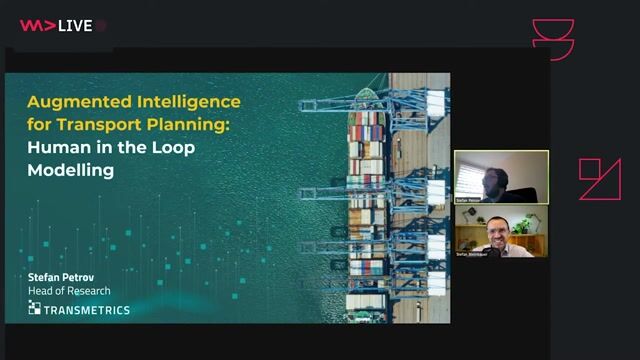
Stefan Petrov
Augmented Intelligence for transport planning: Human in the Loop Modelling
#1about 3 minutes
Applying augmented intelligence to logistics planning
Decision support systems can solve complex logistics problems by combining statistical estimation and operational research.
#2about 6 minutes
Understanding different mathematical optimization techniques
Techniques like linear, mixed-integer, and convex programming provide a powerful declarative way to model and solve business problems.
#3about 4 minutes
Why human planners often distrust optimization models
Planners may reject optimized solutions due to unstated constraints, responsibility concerns, and a mismatch between global optimization and local decision-making.
#4about 4 minutes
How models learn incorrect correlations from data
Examples like classifying wolves by snow in the background show how models can achieve high accuracy for the wrong reasons, justifying user skepticism.
#5about 3 minutes
Declarative models versus imperative human thinking
Optimization models require full commitment to a declarative plan, whereas humans prefer an imperative, step-by-step approach with partial execution and replanning.
#6about 2 minutes
A human-in-the-loop framework for building trust
A proposed workflow involves generating suggestions, allowing planners to review and provide final decisions, and giving them tools to examine and modify results.
#7about 7 minutes
Using probabilistic programming for incomplete data
Probabilistic programming helps estimate missing package dimensions by modeling the data generation process, allowing for flexible handling of missing values and incorporating expert knowledge.
#8about 5 minutes
Techniques for model interpretability and transparency
Building user trust involves making models more transparent by extracting human-readable rules and clearly visualizing the uncertainty in their predictions.
#9about 8 minutes
Interactive scenario planning and constraint editing
Allowing users to collaboratively build models through scenario analysis and then interactively edit constraints in real-time bridges the gap between optimization and practical operations.
#10about 3 minutes
Conclusion: Achieving symbiosis between humans and AI
The key to successful adoption is creating a symbiotic relationship where expert users can guide and interact with optimization models through thoughtful UI and solution presentation.
Related jobs
Jobs that call for the skills explored in this talk.

Matching moments
05:03 MIN
Q&A on ethics, model deployment, and regional data
Finding the unknown unknowns: intelligent data collection for autonomous driving development

03:58 MIN
Using AI and data sharing for smarter urban planning
Smart City, Smart Mobility

05:53 MIN
Overcoming AI model limitations with expert knowledge
Are frameworks like React redundant in an AI world?
05:38 MIN
Designing user experiences for AI-powered applications
WeAreDevelopers LIVE - Is AI replacing developers?, Stopping bots, AI on device & more

04:38 MIN
Designing user experiences with a human in the loop
Bringing the power of AI to your application.
01:21 MIN
Combining human and AI strengths for better decisions
AI for decision-making in Tech Recruiting

02:08 MIN
Exploring other real-world use cases for hybrid AI
Hybrid AI: Next Generation Natural Language Processing
03:31 MIN
Previewing the "AI or knockout" conference talk
From Learning to Leading: Why HR Needs a ChatGPT License
Featured Partners
Related Videos
 35:16
35:16How AI Models Get Smarter
Ankit Patel
 32:26
32:26Bringing the power of AI to your application.
Krzysztof Cieślak
 30:49
30:49AI beyond the code: Master your organisational AI implementation.
Marin Niehues
 59:39
59:39Building Products in the era of GenAI
Julian Joseph
 26:55
26:55How Machine Learning is turning the Automotive Industry upside down
Jan Zawadzki
 52:10
52:10Intelligent Data Selection for Continual Learning of AI Functions
Nico Schmidt
 56:46
56:46Explainable machine learning explained
Karol Przystalski
 56:55
56:55Multimodal Generative AI Demystified
Ekaterina Sirazitdinova
Related Articles
View all articles


From learning to earning
Jobs that call for the skills explored in this talk.


Peter Park System GmbH
München, Germany
Intermediate
Senior
Bash
Linux
Python

Ditec Dr. Kahlich & Langer GmbH
Heidelberg, Germany
Junior
Intermediate
Senior
Python


CONTIAMO GMBH
Berlin, Germany
Senior
Python
Docker
TypeScript
PostgreSQL