Marko Ivanković
Web3 Developer Crash Course
#1about 7 minutes
Understanding the core components of a blockchain transaction
A transaction's key fields like hash, status, gas price, and value are explained as the fundamental building blocks of the blockchain.
#2about 7 minutes
Exploring the basics of smart contracts and Solidity
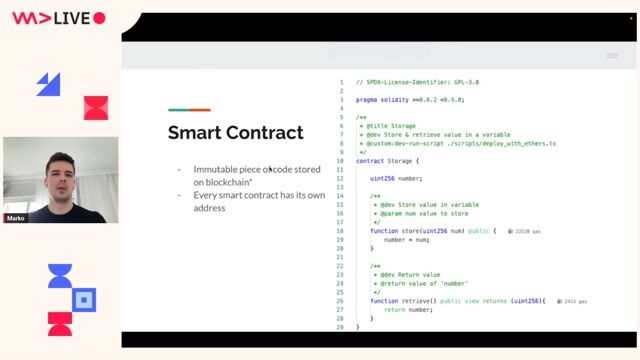
Smart contracts are defined as immutable code on the blockchain, with a line-by-line breakdown of a basic Solidity contract's syntax and structure.
#3about 2 minutes
Following the lifecycle of a smart contract deployment
The process of developing a smart contract involves writing Solidity code, compiling it to bytecode, and sending it to the blockchain via a signed transaction.
#4about 2 minutes
Breaking down the architecture of a decentralized application
A dApp typically consists of an on-chain smart contract for logic and an off-chain front-end for user interaction, sometimes supplemented by a traditional back-end.
#5about 3 minutes
Differentiating between fungible and non-fungible tokens
Token standards like ERC-20 for fungible assets, ERC-721 for unique non-fungible tokens (NFTs), and ERC-1155 for semi-fungible assets are explained.
#6about 6 minutes
Setting up a development environment with Hardhat
A step-by-step guide shows how to initialize a new smart contract project using the Hardhat framework and explains its default folder structure.
#7about 11 minutes
Analyzing the structure of an ERC-721 NFT contract
A practical ERC-721 contract is examined, highlighting the use of OpenZeppelin libraries for security and standard functionality like ownership control.
#8about 6 minutes
Implementing core functions for an NFT minting contract
Key functions like `mint`, `withdraw`, and `tokenURI` are detailed, covering concepts such as `payable` functions, visibility modifiers, and transaction reverts.
#9about 5 minutes
Minting an NFT through a front-end application
A live demonstration shows how to mint an NFT by interacting with a deployed smart contract via a front-end, confirming the transaction with MetaMask.
#10about 7 minutes
Answering common questions about web3 development
The discussion covers beginner resources, real-world blockchain use cases like supply chain, the importance of security, and future trends such as ZK proofs.
Related jobs
Jobs that call for the skills explored in this talk.


Matching moments
04:19 MIN
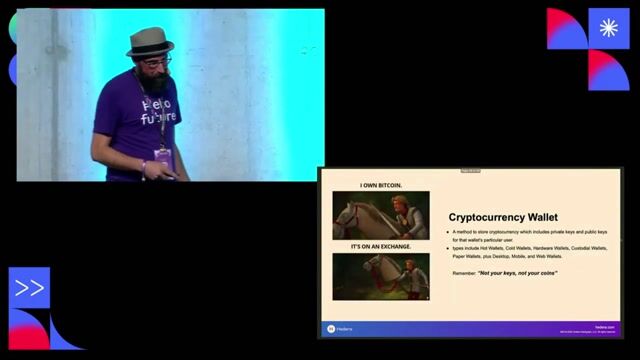
Using smart contracts and developer tools on Hedera
A Primer on Blockchain and Hedera: An Intro Through Terms
Unlock Moments
Create a free account to watch a limited number of Moments each month.
Upgrade to PRO for unlimited access to the full archive.
Upgrade to PRO for unlimited access to the full archive.
You have an account? Log in
06:11 MIN
Essential tools for building a Web3 application
Road to Web3
Unlock Moments
Create a free account to watch a limited number of Moments each month.
Upgrade to PRO for unlimited access to the full archive.
Upgrade to PRO for unlimited access to the full archive.
You have an account? Log in
07:02 MIN
Essential tools for Web3 frontend development
Testing web3 applications
Unlock Moments
Create a free account to watch a limited number of Moments each month.
Upgrade to PRO for unlimited access to the full archive.
Upgrade to PRO for unlimited access to the full archive.
You have an account? Log in
01:23 MIN
How to start a career in DeFi development
The Developer Handbook: How to Build on the Blockchain
Unlock Moments
Create a free account to watch a limited number of Moments each month.
Upgrade to PRO for unlimited access to the full archive.
Upgrade to PRO for unlimited access to the full archive.
You have an account? Log in
01:58 MIN
Q&A on wallet providers and developer tooling
SSO with Ethereum and Next JS
Unlock Moments
Create a free account to watch a limited number of Moments each month.
Upgrade to PRO for unlimited access to the full archive.
Upgrade to PRO for unlimited access to the full archive.
You have an account? Log in
05:02 MIN
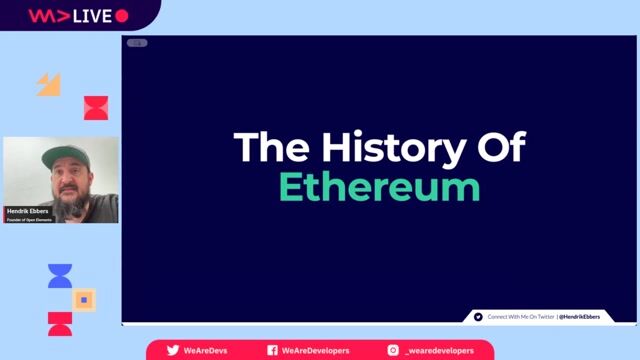
Introducing Ethereum and programmable smart contracts
Blockchain, NFT and smart contracts for my application
Unlock Moments
Create a free account to watch a limited number of Moments each month.
Upgrade to PRO for unlimited access to the full archive.
Upgrade to PRO for unlimited access to the full archive.
You have an account? Log in
06:20 MIN
Interacting with smart contracts using ethers.js
Testing web3 applications
Unlock Moments
Create a free account to watch a limited number of Moments each month.
Upgrade to PRO for unlimited access to the full archive.
Upgrade to PRO for unlimited access to the full archive.
You have an account? Log in
01:06 MIN
Anyone can become a Web3 developer
A Primer on Blockchain and Hedera: An Intro Through Terms
Unlock Moments
Create a free account to watch a limited number of Moments each month.
Upgrade to PRO for unlimited access to the full archive.
Upgrade to PRO for unlimited access to the full archive.
You have an account? Log in
Featured Partners
Related Videos
 42:19
42:19Road to Web3
Soumaya Erradi
 53:58
53:58Testing web3 applications
Soumaya Erradi
 57:38
57:38Blockchain, NFT and smart contracts for my application
Hendrik Ebbers
 49:33
49:33Why chain abstraction is the best way to build successful web3 solutions for users
Alen Meštrov
 30:32
30:32Debunking the Top 10 Myths about Web 3
Ed Marquez
 26:34
26:34Web3: Embracing the Next Era of the Internet Within a Web2 Landscape
Darrel Idiagbor
 49:40
49:40Connect Metamask with web3js
Wisdom Nwokocha
 38:32
38:32Smart Contract fundamentals - My first DApp
Tim Weingärtner
Related Articles
View all articles

.webp?w=240&auto=compress,format)

From learning to earning
Jobs that call for the skills explored in this talk.


tarent solutions GmbH
GIT
HTML
Vue.js
tarent solutions GmbH
GIT
HTML
Vue.js
tarent solutions GmbH
GIT
HTML
Vue.js
Halvotec GmbH
ASP.NET
TypeScript
Software Architecture
The Workshop
Málaga, Spain
DevOps
Docker
RabbitMQ
Cassandra
PostgreSQL
+4